

Range and Rhythm: Muay Thai Kicking Fundamentals
Power may be one of the first things people notice about Muay Thai kicks, but an effective kick depends on much more than how hard someone can strike. Range, timing, balance, footwork, hip rotation, and the ability to recover position all play a role. Developing those fundamentals takes repetition, which is why even experienced Muay Thai practitioners continue refining the same mechanics throughout their training.
Whether you are learning to throw a round kick for the first time or working to make your combinations faster and more effective, understanding range and rhythm is an important part of developing your striking. A powerful technique has limited value if it is thrown from the wrong distance or at the wrong time.
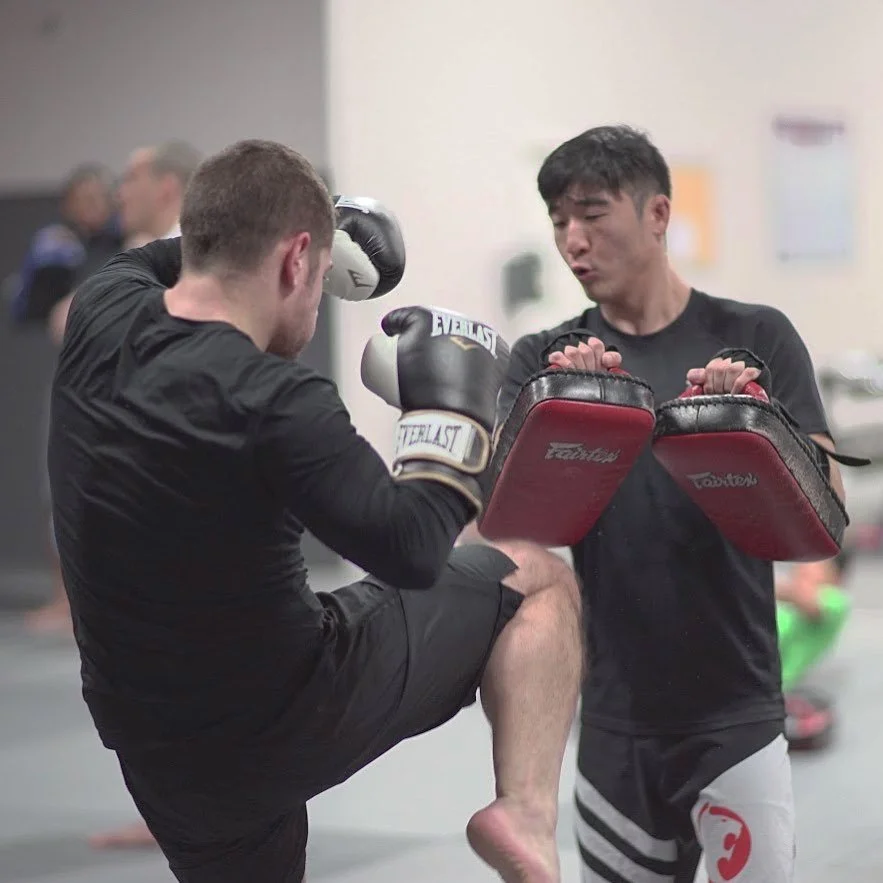
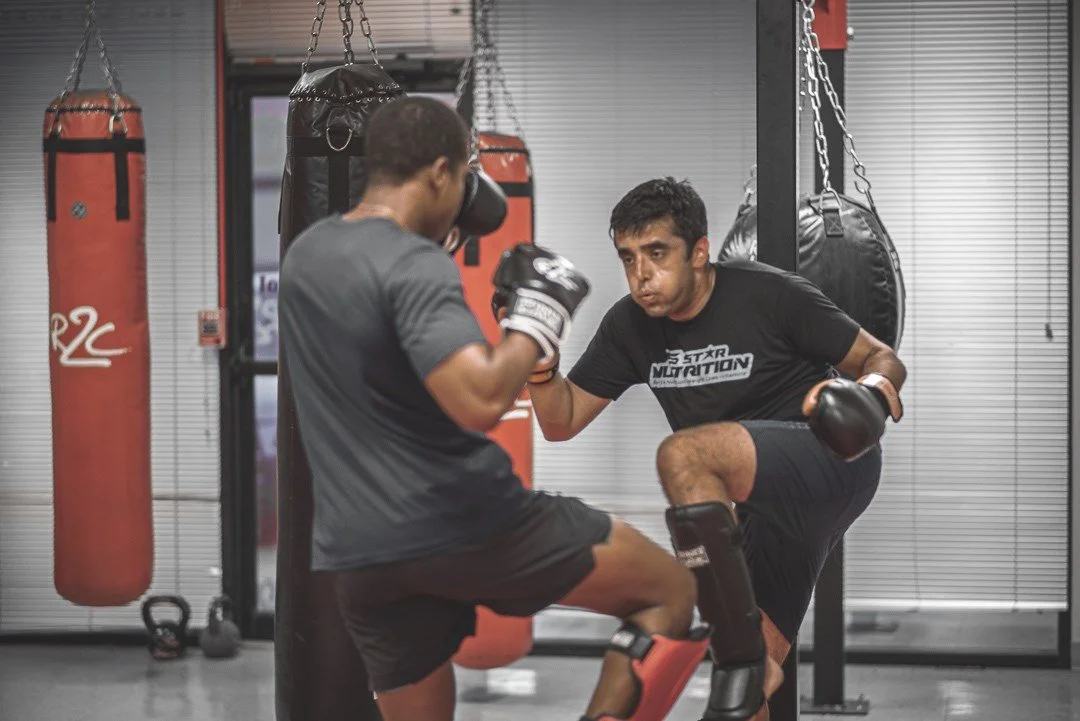
Understanding Range
Every strike has an effective range. Too far away and a kick may fall short or lose effectiveness. Too close and there may not be enough space to execute the technique properly. Learning to recognize and control that distance is a fundamental part of Muay Thai.
Range is also constantly changing. An opponent or training partner may step forward, circle away, change angles, or react to the previous strike. That means students are not simply learning how to kick, they are learning how to position themselves so the kick is available in the first place.
Footwork becomes an important part of that process. Moving into range without losing balance, creating space when necessary, and maintaining a strong position after striking all help set up what happens next. With continued training, students begin to develop a better feel for when they are in position to attack and when they need to adjust first.
The Teep: More Than a Push Kick
The teep is one of Muay Thai's most recognizable and versatile techniques. Often compared to a jab because of the role it can play in controlling an exchange, the teep can help manage distance, disrupt forward movement, interrupt rhythm, and create opportunities for other strikes.
A well-timed teep is not simply about pushing someone backward. Balance, timing, accuracy, and positioning matter. The striker also needs to recover quickly into a strong stance rather than being left off balance after the kick.
As students gain experience, they begin to understand how the teep fits into the larger striking game. It can be used to maintain range, respond to movement, disrupt an opponent's timing, or help set up the next attack. The technique itself may look straightforward, but using it effectively requires an understanding of both distance and timing.
Developing a Strong Round Kick
The Muay Thai round kick is known for its power, but that power comes from coordinated movement rather than simply swinging the leg harder. The supporting foot, hip rotation, balance, posture, and timing all contribute to an effective kick.
Learning the mechanics is only part of the process. Students also need to understand where the kick fits within an exchange. A round kick can be thrown on its own, used after punches, incorporated into combinations, or timed in response to an opponent's movement. The setup can be just as important as the kick itself.
Repetition on pads, bags, and through partner drills gives students opportunities to refine those mechanics while developing speed, accuracy, and control. Over time, movements that initially required deliberate thought begin to become more natural, allowing students to focus less on the individual pieces of the technique and more on how and when to use it.
Finding Rhythm Without Becoming Predictable
Rhythm in Muay Thai is not about moving at the same pace throughout a round. In fact, becoming too predictable can make strikes easier to read. Developing rhythm means becoming comfortable with movement, recognizing openings, and understanding when to attack, defend, reset, or change the pace.
This is where combinations become especially important. Punches can create openings for kicks, a teep can disrupt an opponent before another attack, and changes in timing can make familiar techniques harder to anticipate. As students become more comfortable with individual strikes, they begin learning how those techniques connect rather than treating every punch or kick as an isolated movement.
Partner drills and controlled live training add another layer because the person in front of you is no longer stationary. Distance changes, openings disappear, and techniques require adjustment. Students learn to react to what is happening rather than simply repeating a predetermined sequence.
When that distance closes completely, a different part of Muay Thai comes into play. Our earlier look at Muay Thai Clinch Basics explores what happens when fighters move from kicking and striking range into the clinch.
Technique Before Power
There is nothing wrong with wanting to kick harder. Developing power is part of Muay Thai, but power becomes much more useful when it is supported by sound technique.
A student who understands balance, range, timing, and positioning has a stronger foundation for developing speed and power without sacrificing control. Those fundamentals also make it easier to recover after a strike, continue a combination, defend a counter, or change position instead of becoming committed to a single attack.
This is one reason fundamental techniques remain relevant at every experience level. The round kick does not stop being important once someone has trained for years, nor does the teep become a "beginner" technique. As a student's Muay Thai develops, the details and applications of those fundamentals continue to develop with it.
Kicking is also only one part of Muay Thai's broader striking system. Our guide to Muay Thai strategy and the art of the eight limbs takes a closer look at how punches, kicks, elbows, and knees work together.
Putting It Together on the Mats
Range, rhythm, timing, and technique are not separate parts of Muay Thai. They work together every time a student moves into position, throws a combination, responds to a training partner, or resets after an exchange.
For newer students, that may mean becoming comfortable with stance, footwork, the teep, and the mechanics of a round kick. More experienced students may be refining timing, disguising their attacks, changing rhythm, improving combinations, or making small technical adjustments that create a noticeable difference in their striking.
That ongoing progression is part of what makes Muay Thai such a challenging and rewarding martial art. There is always another detail to sharpen, another combination to work on, and another opportunity to improve how technique is applied against someone who is moving and reacting in real time.
At Ground Control Owings Mills, Muay Thai Kickboxing gives students the opportunity to develop those skills through consistent training while building their striking from the fundamentals up. Whether you are stepping onto the mats for your first class or have thrown a round kick a thousand times, there is always another level to refine.